NASA CHAPEA Crew Completes 378 Days Inside Mars Simulation
Four volunteer scientists officially emerged from NASA’s 3D-printed Mars habitat at Johnson Space Center on Tuesday, concluding an extraordinary 378-day isolation mission simulating long-duration human survival on the Red Planet.
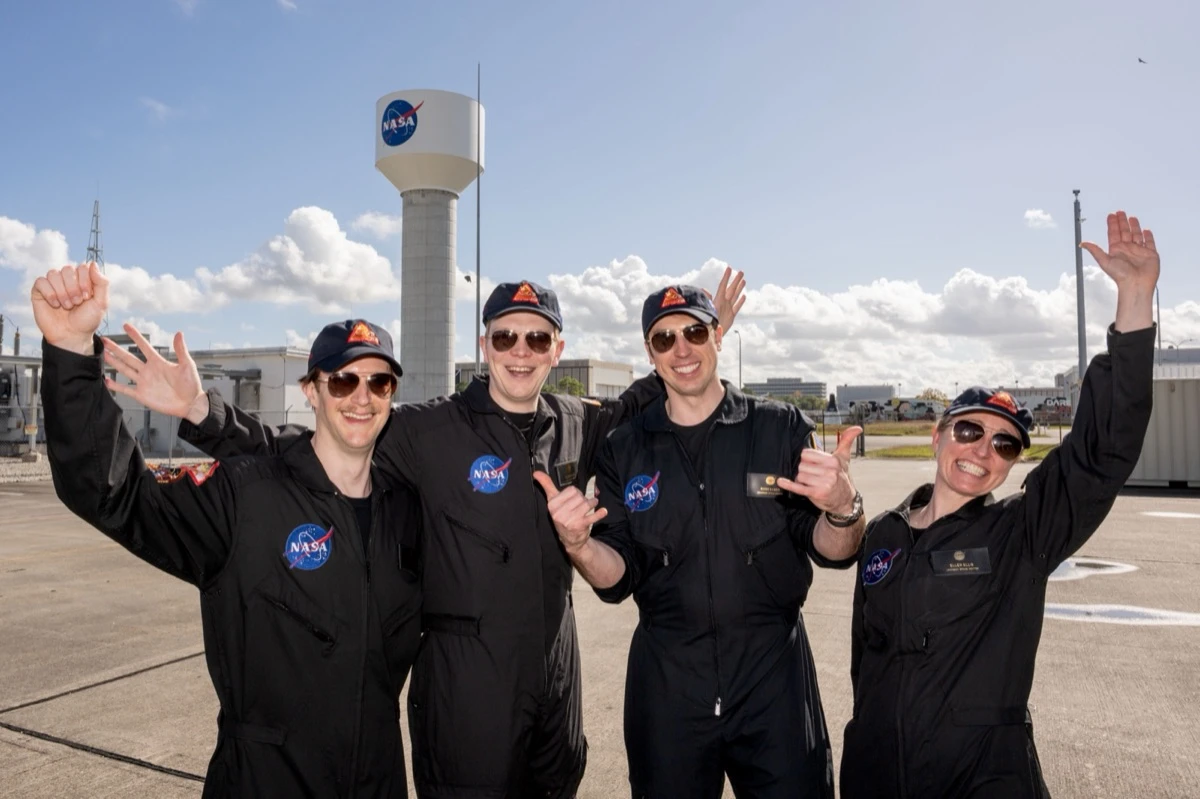
- Four volunteer researchers emerge from 3D-printed habitat after spending 378 days in simulated Mars mission.
- Conducted simulated Marswalks, grew hydroponic crops, and endured 22-minute communications time delays.
- Telemetry will guide environmental life-support systems and behavioral protocols for Artemis and Mars crews.
HOUSTON — Emerging into natural daylight for the first time in more than a year to enthusiastic cheers from mission controllers, family members, and NASA scientists, four volunteer researchers officially completed the second CHAPEA (Crew Health and Performance Exploration Analog) mission on Tuesday morning. The pioneering four-person crew spent an extraordinary 378 consecutive days sealed inside "Mars Dune Alpha"—a 1,700-square-foot, 3D-printed habitat located inside a cavernous hangar at the Johnson Space Center in Houston, Texas—generating invaluable empirical data that will directly safeguard future astronauts traveling to the Moon and Mars.
The multidisciplinary analog crew—composed of a mission commander, a medical officer, a mechanical engineer, and an environmental microbiologist—entered the sealed habitat in late autumn 2025. Over the course of twelve and a half months, the team lived under rigorous, hyper-realistic operational constraints designed to mirror the harsh realities of interplanetary living. All communications with mission control were subjected to a built-in twenty-two-minute speed-of-light time delay, while the crew was forced to manage strictly rationed water reserves, cultivate high-nutrient crops under specialized LED hydroponic systems, and execute regular maintenance on complex environmental life-support machinery.
A centerpiece of the 378-day mission involved extensive simulated extravehicular activities, or "Marswalks." Stepping through a specialized airlock into an adjacent 1,200-square-foot red-sand enclosure, crew members donned pressurized spacesuit replicas to conduct geological rock sampling, assemble robotic sensor arrays, and navigate emergency obstacle courses across challenging simulated Martian terrain. Physiological sensors continuously tracked crew biometric vitals, sleep architecture, bone density fluctuations, and cognitive performance under chronic environmental stress.
Behavioral scientists emphasized that the psychological findings harvested from the mission represent some of the most critical telemetry in NASA's deep-space portfolio. Prolonged confinement in isolated, confined environments poses profound psychological risks, including sensory deprivation, circadian rhythm disruption, and interpersonal friction. By demonstrating exceptional psychological resilience, adaptive conflict resolution, and consistent operational efficiency, the CHAPEA-2 crew proved that human teams can maintain peak performance during multi-year deep-space transits.
"Stepping out of that airlock today is deeply emotional, but the real triumph belongs to the scientific mission we completed inside," said mission commander Dr. Jason Alvarez during the post-emergence welcoming ceremony. "Every harvest we grew, every delayed transmission we worked through, and every simulated spacewalk we executed brings humanity one step closer to leaving permanent footprints on the rust-colored sands of Mars. The red planet is no longer just a distant dream; it is our next frontier."
Congressional testimony scheduled for later this month is expected to address cross-agency coordination, focusing specifically on supply chain resiliency, sovereign compute clusters, and long-term capital allocation strategies designed to safeguard domestic competitiveness.